
Takeaway: Non-crime civic signals (311 pothole complaints) add little predictive power to burglary risk once neighborhood context is considered.
Overview This project evaluates whether 311 alley pothole complaints can improve burglary prediction in Chicago beyond baseline spatial models, testing the usefulness of non-crime civic data in predictive policing contexts.
Key Outputs
- Analytical report: Chicago Burglary & Pothole Analysis
- Code repository: GitHub repository
Methods
- 500m × 500m fishnet grid
- Spatial joins and nearest-neighbor feature engineering
- Local Moran’s I and LISA cluster analysis
- Poisson and Negative Binomial regression
- KDE baseline comparison
- Leave-One-Grid-Out spatial cross-validation
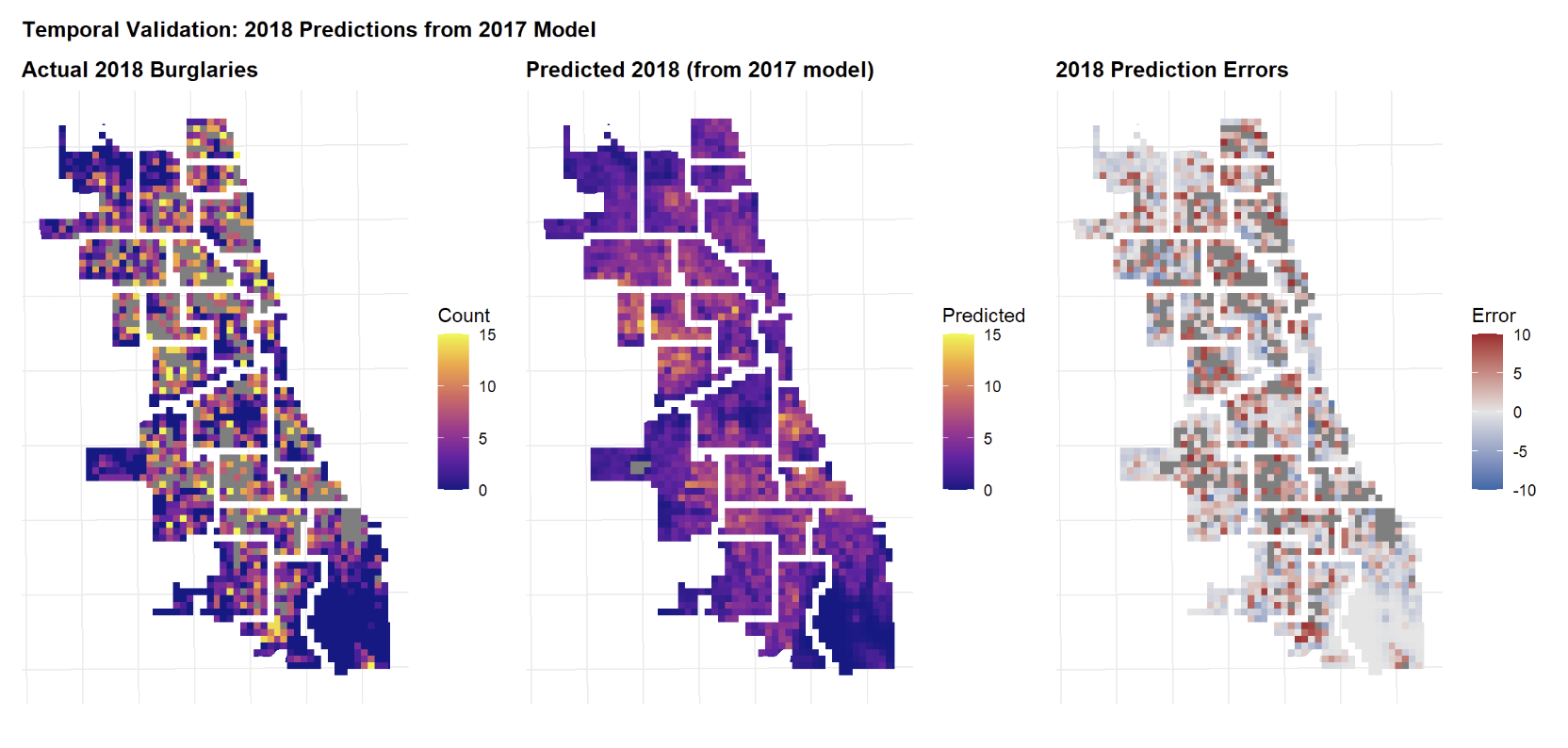
- Temporal validation using 2018 burglary outcomes
Key Findings:
- Pothole complaints showed weak independent predictive power after controlling for socioeconomic variables (very expected)
- KDE baselines slightly outperformed regression models in raw predictive accuracy.
- Spatial generalization was moderate, while temporal generalization was weaker.